

New Perspectives on High-resolution Imaging in Musculoskeletal MRI Using Deep Learning
Takahide Kakigi, MD, PhD

High-resolution and thin-slice 2D images using deep learning technology are useful in diagnosing in musculoskeletal disease. This report describes the usefulness of Advanced intelligent Clear-IQ Engine (AiCE) in 2D thin-slice imaging of the shoulder joint as previously performed at Kyoto University Hospital and also discusses the new high-resolution technology known as Precise IQ Engine (PIQE) for obtaining higher resolution images in a shorter acquisition time. Both of these technologies were developed by Canon Medical Systems Corporation. Finally, this report presents thin-slice 2D imaging of shoulder joint that can be made with higher resolution and shorter acquisition times by using PIQE.
Usefulness of AiCE in 2D thin-slice imaging of the shoulder joint
AiCE is advanced technology based on deep learning that allows high signal-to-noise ratio (SNR) images to be created from low SNR images. Specifically, high-quality teaching images are employed to train a deep convolutional neural network (DCNN). When AiCE is installed in an MRI system, the noise contained in newly acquired low-SNR images can be substantially reduced, making it possible to obtain high-SNR images similar to the high-quality teaching images used to train the DCNN. Because training is performed using only the high-frequency components, AiCE is applicable to a wide range of sequences.
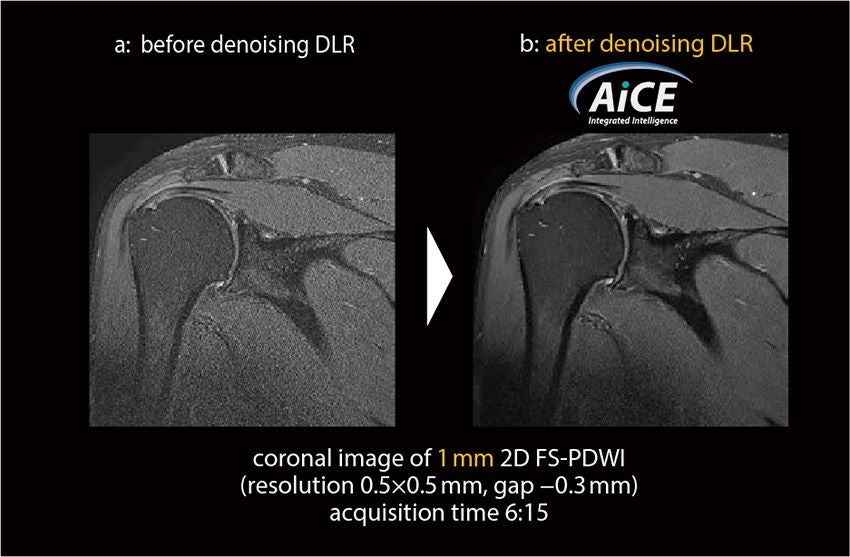
On the other hand, there are a number of challenges which must be overcome to expand the clinical application of AiCE. The acquisition time is slightly longer when acquiring images with a gap of −0.3 mm to generate MPR images with a slice thickness of 1 mm. In examinations where a relatively small field of view (FOV) is required, such as hand and elbow joints, the SNR may be insufficient even when AiCE was used to obtain an in-plane resolution equivalent to that in the shoulder joint. Furthermore, when using SPEEDER, Compressed SPEEDER (CS), advanced Fourier imaging (AFI), etc., an excessive increase in the acceleration rate can result in a decrease in SNR and poor image quality, and in addition, increasing the number of echoes per TR results in increased blurring. This presents something of a dilemma in condition setting. However, these issues can be overcome by PIQE.
Clinical usefulness of PIQE
1. Advantages of higher resolution by using PIQE
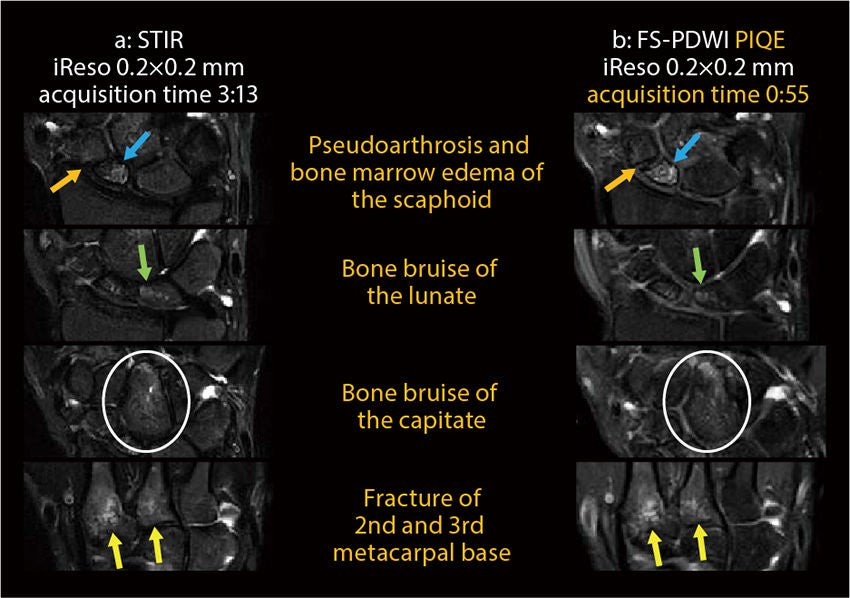
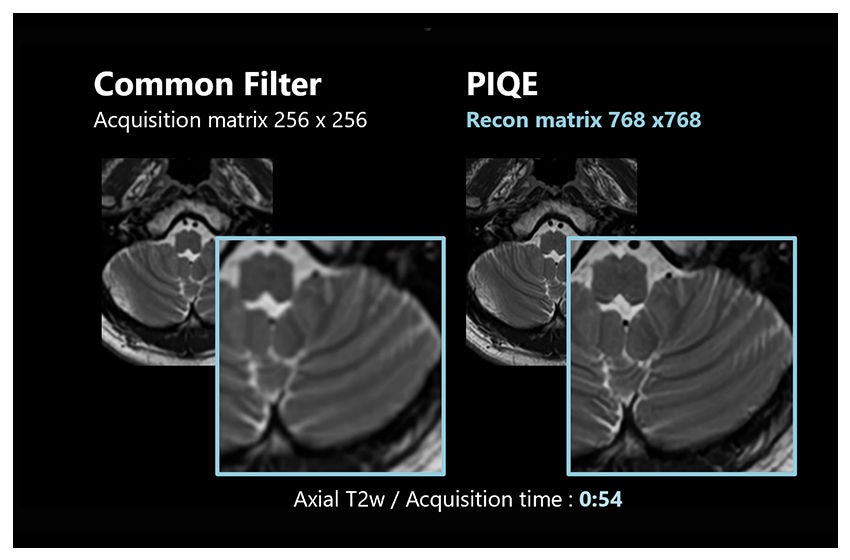
In order to generate high SNR and resolution images from low SNR and resolution images, PIQE employs two deep learning reconstruction (DLR) technologies: denoising and up-sampling. PIQE, like AiCE, can compensate for the reduction in SNR when the resolution is increased. In addition, PIQE has the following features beyond those of AiCE: 1) the matrix can be increased by a factor of 3×3 to improve resolution, 2) contrast can be maintained because the resolution of the original image can be reduced, and 3) the reduction in contrast caused by an excessively high resolution can be minimized because scanning is performed at a lower resolution, thus improving tissue contrast.
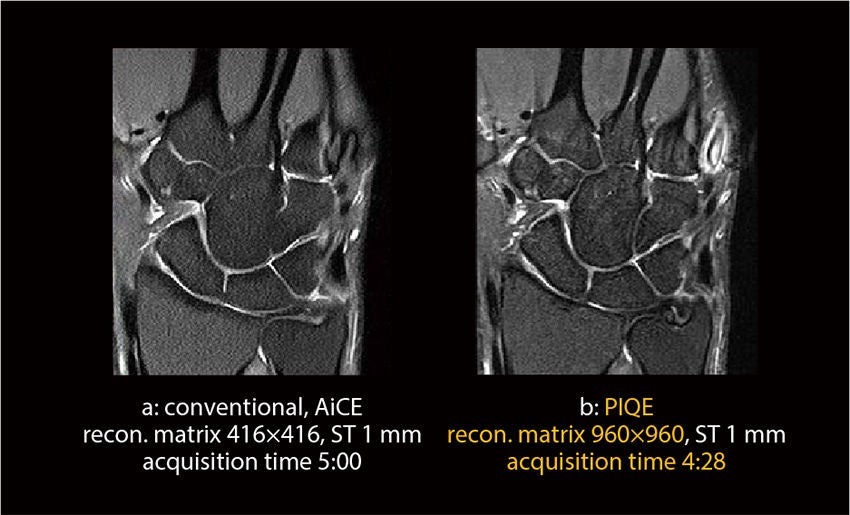
Figure 3 shows 1-mm 2D FS-PDWI acquired with PIQE in a patient with a lunate fracture and TFCC injury. Bone marrow edema is seen in the lunate bone, and a sagittal image (a) shows a free bone fragment (orange arrow) on the dorsal aspect of the lunate bone. In a coronal image (b) and a sagittal image (c), fluid (blue arrows) is seen in the articular disk of the TFCC, indicating the presence of injury. The lesion can be observed from both coronal and sagittal directions in 1-mm 2D images.
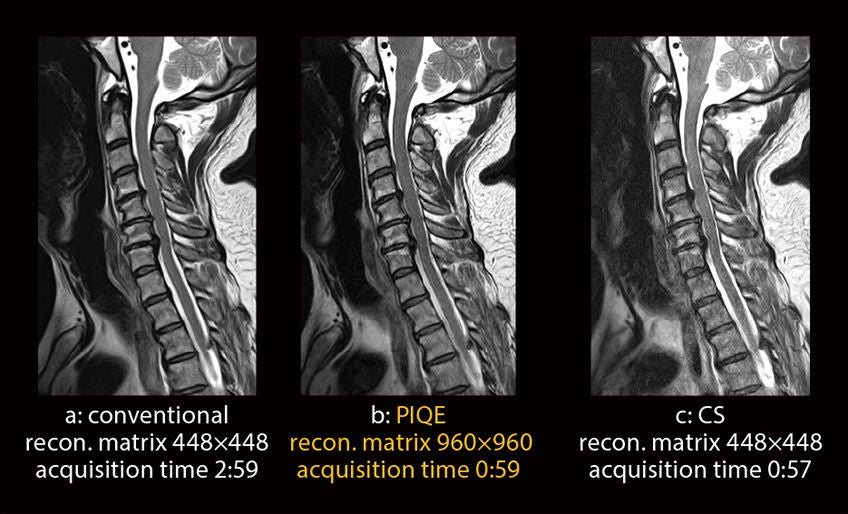
Figure 4 shows T2-weighted images (T2WI) of a patient with cervical disc bulging and herniation. Compared to the original image (a), structural details are more precisely depicted with PIQE (b). The cervical cord is also clearly visualized, and abnormal findings such as cervical edema and myelomalacia can easily be identified.
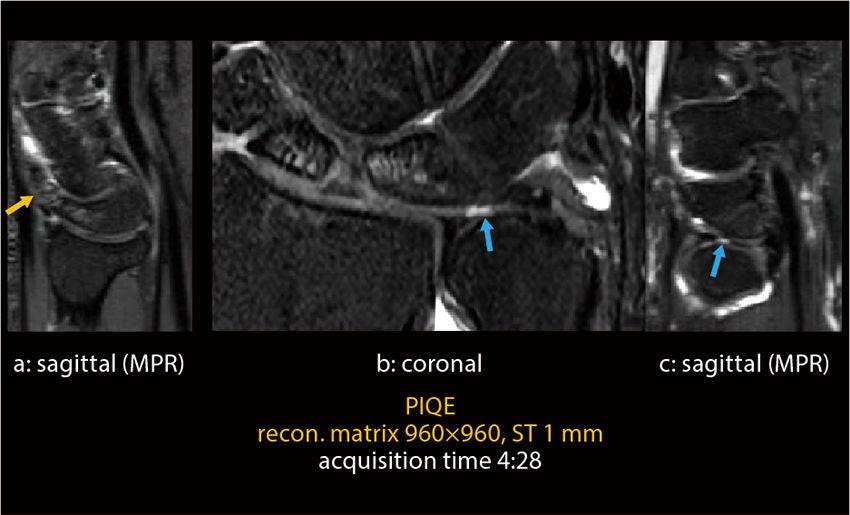
Figure 3: 1-mm 2D FS-PDWI with PIQE in a patient with a lunate fracture and TFCC injury
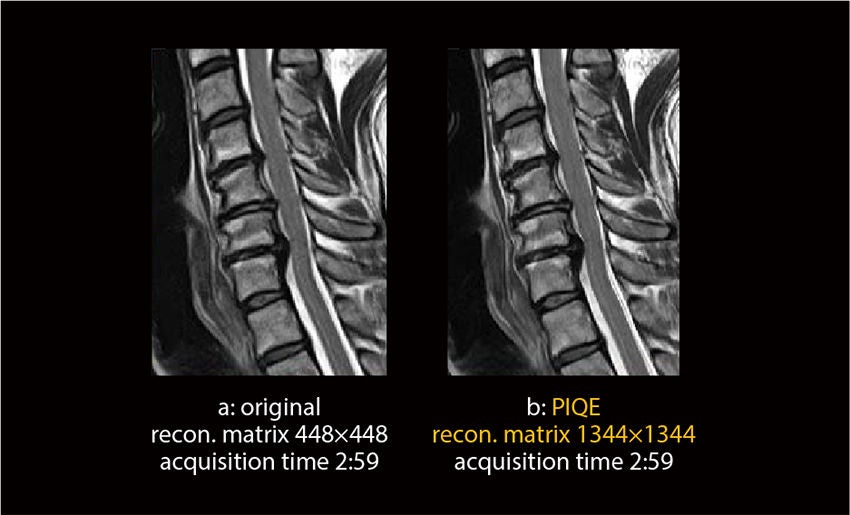
Figure 4: Comparison of images with and without PIQE for evaluating cervical disc bulging and herniation
2. Application of PIQE to reductions in acquisition time
AiCE eliminates noise caused by the decrease in SNR due to increasing the acceleration rate of SPEEDER or CS and reducing the number of acquisitions to achieve reductions in acquisition time. With PIQE, on the other hand, the resolution can be increased at the time of image reconstruction, allowing the acquisition time to be shortened by reducing the matrix in the phase encoding direction during acquisition. This also means that the acceleration rate of SPEEDER or CS can be reduced, resulting in more stable image quality.
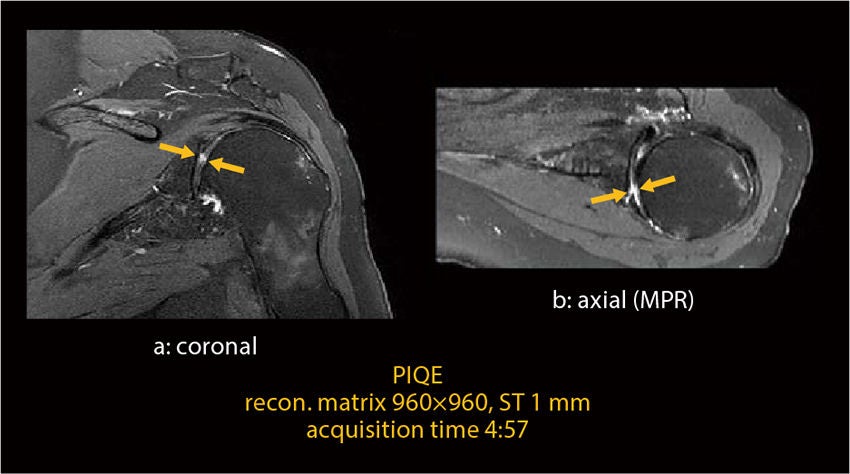
New perspectives on thin-slice 2D imaging of the shoulder joint — Achieving higher resolution with shorter acquisition times
At Kyoto University Hospital, an acquisition time of 6 minutes and 15 seconds was still required for 1-mm 2D FS-PDWI of the shoulder even when AiCE was used in combination to ensure good image quality. But with PIQE, the acquisition time could be shortened to only 4 minutes and 57 seconds. We have found the ability to obtain higher resolution images in a shorter acquisition time to be of great clinical value at our hospital.
Conclusion
AiCE allows us to obtain 1-mm 2D images and MPR images that can provide extremely useful clinical information. Furthermore, the introduction of PIQE has led to higher resolution and shorter acquisition times even in small FOVs, which has long been a major challenge. With the use of PIQE, we are now able to achieve both high resolution and high contrast with short acquisition times, making it much easier to perform high-resolution musculoskeletal imaging. New perspectives on advanced technologies is eagerly anticipated.//

Takahide Kakigi, MD, PhD
Department of Diagnostic Imaging and Nuclear Medicine,
Kyoto University Graduate School of Medicine, Japan
Department of Diagnostic Imaging and Nuclear Medicine,
Kyoto University Graduate School of Medicine, Japan
This article is a translation of the INNERVISION magazine, Vol.38, No.6, 2023.
Disclaimer
The contents of this report include the personal opinions of the author based on his clinical experience and knowledge. Deep learning technology is used in the design stage of the image reconstruction processing for AiCE and PIQE. The system itself does not have self-learning capabilities.
Learn more about Canon Medical's MRI technologies and products

The content reflects information available at the time of publication and may differ from current information.
Social Media


