



Never let a good crisis go to waste
From iodine contrast shortage to environmental sustainability
By Joanne D. Schuijf, PhD.
June 16, 2022
Dr. Joanne Schuijf is a Clinical Research Manager working as a member of the Global Research & Development Center at Canon Medical Systems Europe. She is an expert on cardiovascular imaging with over 15 years of experience in the field.
Contrast reduction: How can patients benefit?
For many imaging procedures, contrast agents - such as iodinated contrast for CT and gadolinium-based contrast agents for MRI - play a crucial role in improving the detection and characterization of abnormalities. Although the administration of contrast agents is generally safe, allergic responses can occur while also caution is required in case of renal impairment. Thus, for each patient the potential negative effects of using contrast are weighed against the benefits of the diagnostic or therapeutic procedure and, ideally, the administration of contrast agents is restricted as much as possible. As the population ages, the number of patients with relative contraindications to contrast is expected to increase since renal function declines with age. Recently, concerns have also been raised due to the observation of gadolinium retention, particularly in the setting of repeated imaging. Thus, strategies to reduce patient exposure are warranted. Such considerations of patient safety are fueling the development of imaging approaches to either reduce the amount of contrast or even providing contrast-free alternatives to limit contrast related complications.
Contrast reduction: How can hospital finance benefit?
More efficient use of contrast materials also makes sense from a financial perspective. In general, the benefits of contrast administration through improved diagnostic performance offset the financial costs of contrast agent. However, in times of increasing financial restriction, strategies to improve operational efficiency and minimize costs are mandated. Several studies have investigated the potential cost-savings when changing from single-use vials to multi-patient injection systems. Routhier et al. 1 showed for 3 major CT indications (pulmonary embolism, head and neck, abdomen and pelvis) that such an approach could reduce the average amount of contrast agent used and translate to annual cost savings of $31,800. Likewise, Struik et al. 2 pointed to increased operational efficiency and lower costs for MRI.
Contrast reduction: How can the environment benefit?
Reducing resource consumption is crucial to support the transition towards more environmentally sustainable healthcare 3. In this context, the negative consequences of medical pharmaceuticals on the environment are a growing problem that calls for awareness and action worldwide. With rising levels of care, human pharmaceuticals are increasingly found in our waterways, posing a risk to the natural environment and our health. Contrast materials are no different. As contrast agents are excreted from the body via the urine, they also enter the aquatic environment through our sewage systems. Contrast media and their byproducts are now commonly detected in our rivers, lakes and drinking water supply systems 4-6. Indeed, during the past decades, concentrations have been found to increase in direct relation to growth in imaging utilization and as such are expected to rise further 4-6. It is important to realize that while contrast media themselves are relatively safe with low toxicity, their byproducts may not have the same risk profile. Moreover, contrast agents and their byproducts are difficult to completely remove from water during purification processes. Such observations provide another important argument to invest in strategies to reduce contrast media use and waste.
Contrast reduction: How can technical innovations contribute?
Multi-patient dosage systems and saline flush techniques can minimize the amount of wasted contrast material, while urine collection bags have been shown to reduce entry into the sewage system 6. However, from a patient perspective, it is preferable to optimize the amount of contrast administered. In this regard, weight-based dosing is an important first step. The contrast shortage also created awareness that protocols for certain indications could safely be shifted to non-contrast CT protocols. Nonetheless, for those indications that do require enhancement with contrast agents, technological advancements may provide important opportunities to further reduce contrast dose.
During the past decades, engineers from Canon Medical Systems have been actively pursuing strategies to limit the need for contrast materials. More recently, developments in artificial intelligence have been added to technologies available for this purpose. As shown in the image below for CT, combining (Deep Learning Reconstruction algorithm, such as with Advanced intelligent Clear-IQ Engine (AiCE) with low kVp or spectral techniques allows to maintain or increase arterial enhancement while using less contrast.
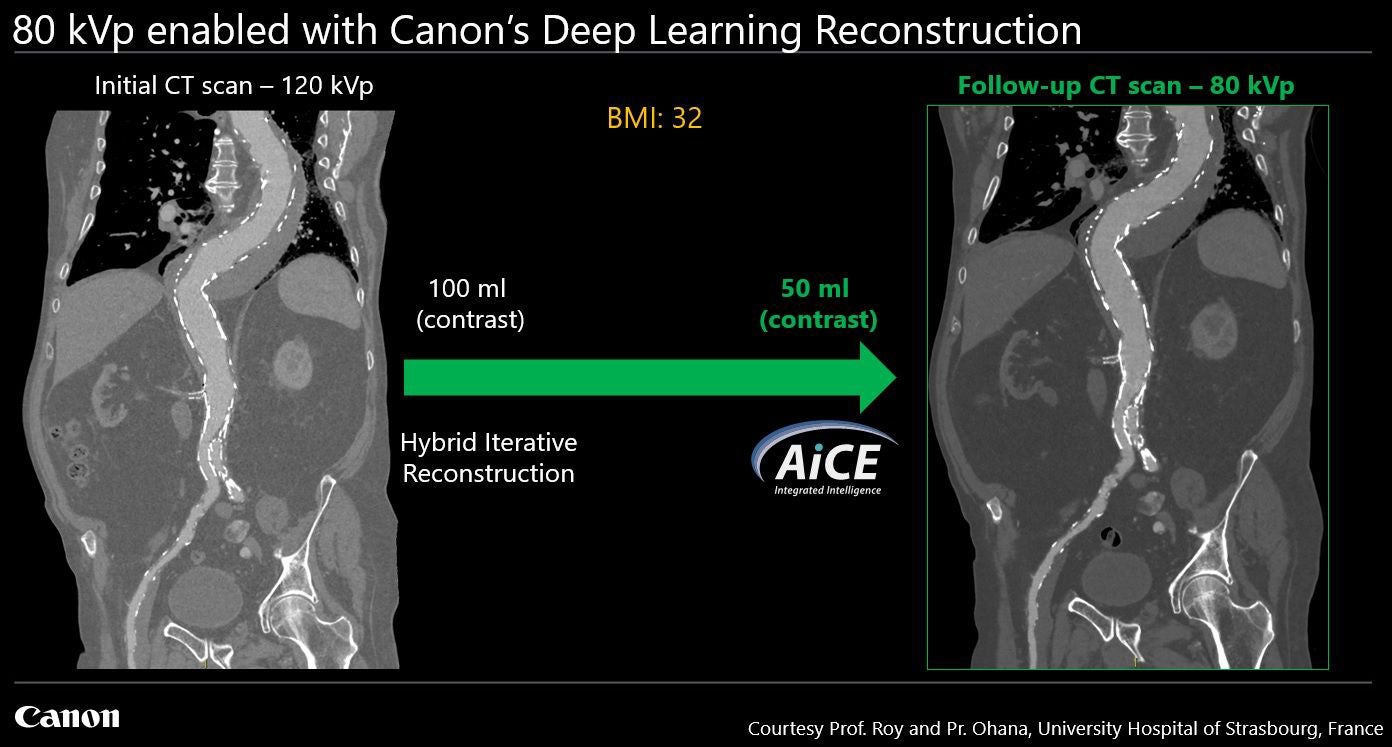
Canon Medical’s Advanced intelligent Clear-IQ Engine (AiCE) deep learning reconstruction powered by Altivity in combination with low KVp allows a considerable reduction of contrast. Image courtesy Prof Roy and Prof Ohana, University Hospital of Strasbourg, France.
Other approaches to contrast media optimization are also available from Canon Medical. In CT, the virtual contrast boost technique uses a sophisticated 3D algorithm to boost the contrast-enhanced signal. High technical efficiency with substantially lower contrast use was recently demonstrated in the interventional setting using a state-of-the-art Angio CT system for liver ablations 7. In MRI, pioneering work is taking contrast reduction even further by eliminating its use entirely in angiographic applications 8,9. Continuous improvement and further expansion to other indications remain areas of active research and development 8,10.
Key takeaways
Contrast agents remain crucial for imaging diagnostics and interventions. While reducing contrast may not always seem worth the effort or a priority, it is our responsibility as healthcare providers to reduce patient and environmental exposure to contrast agents as much as possible.
Reduction of contrast media use has important benefits:
Reduction of contrast media use has important benefits:
- For patients by reducing complications
- For hospitals by reducing costs
- For the planet by reducing environmental pollution
- Reduction of contrast waste
- Reduction of contrast volume per examination
- Development of contrast-free alternatives
Other blogs that may interest you
References
1. Justin Routhier et al. | Contrast and cost savings by implementation of a multidose bulk IV contrast delivery system | J am Coll Radiol. 2011
2. F Struik et al. | Performance of single-use syringe versus multi-use MR contrast injectors: a prospective comparative study | Sci Rep 2020
3. Canon Medical Systems Corporation. CSR Report 2021. https://global.medical.canon/about/csr/csr2021_csr-policy
4. Vanessa Hatje et al. | Increases in Anthropogenic Gadolinium Anomalies and Rare Earth Element Concentrations in San Francisco Bay over a 20 Year Record | Environ Sci Technol. 2016
5. Kazumasa Inoue et al. | Impact on gadolinium anomaly in river waters in Tokyo related to the increased number of MRI devices in use | Mar Pollut Bull. 2020
6. Helena M Dekker et al. | Tackling the increasing contamination of the water supply by iodinated contrast media | Insights Imaging. 2022
7. Qian Yu et al. | Real-time arteriography-directed percutaneous microwave ablation for small or poorly characterized hepatic lesions using hybrid Angio-CT | Abdom Radiol (NY) 2022
8. Yoko Kato et al. | Non-contrast coronary magnetic resonance angiography: current frontiers and future horizons | MAGMA. 2020
9. Canon Medical Systems Corporation. Non-Contrast Imaging. https://global.medical.canon/products/magnetic-resonance/non_contrast
10. Joanne D Schuijf et al. | Cardiovascular ultrashort echo time to map fibrosis-promises and challenges | Br J Radiol. 2019
Social Media


