


Latest news from our
VISIONS Magazine

THE POWER OF CTA AND CTP FOR CHARACTERIZATION OF ISCHEMIA WITHOUT OBSTRUCTIVE STENOSIS
February 10, 2021
Patients presenting with symptoms or other signs of myocardial ischemia in the absence of any significant epicardial coronary stenosis are at present underdiagnosed and undertreated as the current diagnostic pathway remains oriented towards finding obstructive coronary disease. Combined anatomic and functional imaging provided with coronary CT angiography (CTA) and myocardial CT perfusion (CTP) could address an important need to better identify these patients.
A large percentage of patients undergoing invasive coronary angiography do not show significant obstructive coronary artery disease (CAD), despite their symptoms of chest pain1. This finding, called ischemia without obstructive stenosis or INOCA, is reported in up to two thirds of patients and is more common in women1.
Given the absence of any significant stenosis, these patients are not candidates for revascularization, are often falsely reassured and are frequently not offered any specific treatment or follow-up. Yet, studies have consistently shown that these patients are still at elevated risk for cardiovascular events, indicating the need for adequate and timely recognition of this condition2.
Coronary CTA has become an established imaging test for the clinical work-up of patients presenting with chest pain3.
During the same session also myocardial perfusion imaging can be performed to assess the presence of ischemia, a strategy that further enhances the diagnostic accuracy of cardiac CT and is increasingly applied4.
In the unique global multicenter CORE320 trial, 381 patients with suspected or known CAD were enrolled to undergo both coronary CTA and stress CTP using the Aquilion ONE from Canon Medical Systems in addition to invasive coronary angiography and SPECT perfusion imaging, regardless of stenosis severity5. The trial confirmed high accuracy of combined coronary CTA and CTP obtained with wide area detector CT to identify patients with flow-limiting CAD as defined by a significant stenosis on invasive coronary angiography and a corresponding perfusion defect on SPECT imaging5. The CATCH2 trial built on to this experience and, again using the Aquilion ONE, showed in 600 patients that a post-discharge diagnostic strategy of coronary CTA and CTP safely reduced the need for invasive examination and treatment in patients suspected of CAD6.
Given the absence of any significant stenosis, these patients are not candidates for revascularization, are often falsely reassured and are frequently not offered any specific treatment or follow-up. Yet, studies have consistently shown that these patients are still at elevated risk for cardiovascular events, indicating the need for adequate and timely recognition of this condition2.
Coronary CTA has become an established imaging test for the clinical work-up of patients presenting with chest pain3.
During the same session also myocardial perfusion imaging can be performed to assess the presence of ischemia, a strategy that further enhances the diagnostic accuracy of cardiac CT and is increasingly applied4.
In the unique global multicenter CORE320 trial, 381 patients with suspected or known CAD were enrolled to undergo both coronary CTA and stress CTP using the Aquilion ONE from Canon Medical Systems in addition to invasive coronary angiography and SPECT perfusion imaging, regardless of stenosis severity5. The trial confirmed high accuracy of combined coronary CTA and CTP obtained with wide area detector CT to identify patients with flow-limiting CAD as defined by a significant stenosis on invasive coronary angiography and a corresponding perfusion defect on SPECT imaging5. The CATCH2 trial built on to this experience and, again using the Aquilion ONE, showed in 600 patients that a post-discharge diagnostic strategy of coronary CTA and CTP safely reduced the need for invasive examination and treatment in patients suspected of CAD6.
“The combination of CTA/CTP can potentially be a more sensitive, more informative and fully non-invasive method to assess CAD as compared to invasive coronary angiography and SPECT imaging.”
Combined anatomic and functional imaging may however also provide important clues for diagnosis and management in those patients who present with chest pain complaints in the absence of any significant epicardial lesions. Recently an ancillary investigation of the CORE320 trial, specifically addressing this question, was published in Radiology with its imaging findings featured on the cover7. The primary objective of the study team was to explore the prevalence of INOCA in this high risk population using CTA and CTP. In addition, advantage was taken of another aspect of cardiac CT, namely that information on coronary atherosclerosis and plaque can simultaneously be derived in addition to the mere detection of coronary stenosis. Thus, patients with INOCA identified on CT were further characterized in terms of their clinical characteristics as well as extent and type of coronary plaques.
“Non-invasive imagers could play a crucial role in recognizing phenotypes beyond obstructive CAD and guide referring physicians in management decisions.”
In the entire study cohort, INOCA was identified on combined CTA and CTP in approximately one of every 10 patients. An image example is shown in Figure 1. While men showed a higher percentage of obstructive CAD, INOCA was seen in twice as much women. In addition, a link with increased body mass index was observed.
Interestingly, patients with INOCA showed a higher plaque burden as compared to patients with normal perfusion on CTP and no stenosis on CTA. Also, high-risk features like positive remodeling and low attenuation plaque were more often seen. Ischemia on CTP in patients with completely normal coronary arteries (without any evidence of plaque) was very rare. These findings suggest that patients with INOCA should be treated medically not only to control their chest pain symptoms, but also to slow down the build-up of atherosclerotic plaques.
Analyses were also performed using invasive coronary angiography and SPECT imaging. Overall, findings were comparable yet less informative. Detailed plaque characterization, which has become almost standard on CTA, cannot be performed using invasive coronary angiography. Also, CTP imaging has a higher sensitivity to detect ischemia and can identify abnormalities in myocardial perfusion even in the presence of only moderate coronary narrowings. While at present SPECT imaging followed by diagnostic invasive coronary angiography is still more common in clinical practice to manage patients with suspected chest pain, the observations from this ancillary study re-affirm that the combination of CTA/CTP can potentially be a more sensitive, more informative and fully non-invasive method to assess CAD. Moreover, given the completely non-invasive and fast nature of CT, patients tend to strongly favor CT over other cardiac examinations8.
More recently, also dynamic CTP has been introduced and further developed allowing the quantification of absolute myocardial blood flow and coronary flow reserve which may further enhance the potential of CTA/CTP for clinical decision making9,10.
Interestingly, patients with INOCA showed a higher plaque burden as compared to patients with normal perfusion on CTP and no stenosis on CTA. Also, high-risk features like positive remodeling and low attenuation plaque were more often seen. Ischemia on CTP in patients with completely normal coronary arteries (without any evidence of plaque) was very rare. These findings suggest that patients with INOCA should be treated medically not only to control their chest pain symptoms, but also to slow down the build-up of atherosclerotic plaques.
Analyses were also performed using invasive coronary angiography and SPECT imaging. Overall, findings were comparable yet less informative. Detailed plaque characterization, which has become almost standard on CTA, cannot be performed using invasive coronary angiography. Also, CTP imaging has a higher sensitivity to detect ischemia and can identify abnormalities in myocardial perfusion even in the presence of only moderate coronary narrowings. While at present SPECT imaging followed by diagnostic invasive coronary angiography is still more common in clinical practice to manage patients with suspected chest pain, the observations from this ancillary study re-affirm that the combination of CTA/CTP can potentially be a more sensitive, more informative and fully non-invasive method to assess CAD. Moreover, given the completely non-invasive and fast nature of CT, patients tend to strongly favor CT over other cardiac examinations8.
More recently, also dynamic CTP has been introduced and further developed allowing the quantification of absolute myocardial blood flow and coronary flow reserve which may further enhance the potential of CTA/CTP for clinical decision making9,10.
“The combination of CTA and CTP, as can be easily performed with the Aquilion ONE, provides a promising opportunity for detailed and non-invasive CAD phenotyping.”
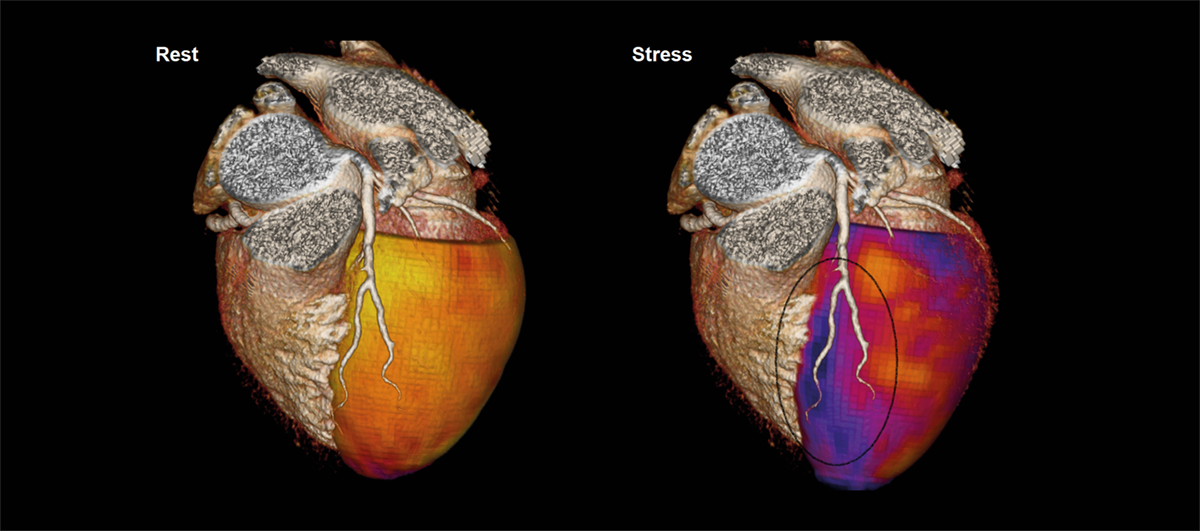 Figure 1. Patient with atypical angina. The presence of any significant stenosis was ruled out on both coronary CTA and invasive coronary angiography. On CTP, a defect corresponding to the LAD territory was identified during stress but not during rest, indicating the presence of ischemia and providing a potential explanation for the patient’s recurrent symptoms.
Summary
The combination of coronary CTA and CTP as can be easily performed with the Aquilion ONE series provides a promising opportunity for detailed and non-invasive coronary artery disease phenotyping, including the characterization of ischemia without obstructive stenosis. Correct identification of the latter is important as these patients do not benefit from revascularization but require optimal medical therapy to improve their prognosis.
As senior author and principal investigator of the CORE320 trial Dr João Lima (Johns Hopkins School of Medicine, Baltimore, USA) points out, non-invasive imagers could play a crucial role in recognizing phenotypes beyond obstructive CAD and guide referring physicians in management decisions. To this end, the combination of CTA and CTP with wide area detector CT will be an important tool. //
As senior author and principal investigator of the CORE320 trial Dr João Lima (Johns Hopkins School of Medicine, Baltimore, USA) points out, non-invasive imagers could play a crucial role in recognizing phenotypes beyond obstructive CAD and guide referring physicians in management decisions. To this end, the combination of CTA and CTP with wide area detector CT will be an important tool. //
You can also download this article as PDF
Other blogs that may interest you
References
1 Kunadian V, Chieffo A, Camici PG, et al. An EAPCI Expert Consensus Document on Ischaemia with Non-Obstructive Coronary Arteries in Collaboration with European Society of Cardiology Working Group on Coronary Pathophysiology & Microcirculation Endorsed by Coronary Vasomotor Disorders International Study Group. EuroIntervention 2020.
2 Bairey Merz CN, Pepine CJ, Walsh MN, Fleg JL. Ischemia and No Obstructive Coronary Artery Disease (INOCA): Developing Evidence-Based Therapies and Research Agenda for the Next Decade. Circulation 2017;135:1075-92.
3 Knuuti J, Wijns W, Saraste A, et al. 2019 ESC Guidelines for the diagnosis and management of chronic coronary syndromes. Eur Heart J 2019;41:407-77.
4 Patel AR, Bamberg F, Branch K, et al. Society of cardiovascular computed tomography expert consensus document on myocardial computed tomography perfusion imaging. J Cardiovasc Comput Tomogr 2020;14:87-100.
5 Rochitte CE, George RT, Chen MY, et al. Computed tomography angiography and perfusion to assess coronary artery stenosis causing perfusion defects by single photon emission computed tomography: the CORE320 study. Eur Heart J 2014;35:1120-30.
6 Sorgaard MH, Linde JJ, Kuhl JT, et al. Value of Myocardial Perfusion Assessment With Coronary Computed Tomography Angiography in Patients With Recent Acute-Onset Chest Pain. JACC Cardiovascular imaging 2018;11:1611-21.
7 Schuijf JD, Matheson MB, Ostovaneh MR, et al. Ischemia and No Obstructive Stenosis (INOCA) at CT Angiography, CT Myocardial Perfusion, Invasive Coronary Angiography, and SPECT: The CORE320 Study. Radiology 2020;294:61-73.
8 Minhas A, Dewey M, Vavere AL, et al. Patient Preferences for Coronary CT Angiography with Stress Perfusion, SPECT, or Invasive Coronary Angiography. Radiology 2019;291:340-8.
9 Kikuchi Y, Oyama-Manabe N, Naya M, et al. Quantification of myocardial blood flow using dynamic 320-row multi-detector CT as compared with (1)(5)O-H(2)O PET. European radiology 2014;24:1547-56.
10 Tsuneta S, Oyama-Manabe N, Kameda H, et al. Improvement of image quality on low-dose dynamic myocardial perfusion computed tomography with a novel 4-dimensional similarity filter. Medicine (Baltimore) 2020;99:e20804.
Social Media


