


Latest news from our
VISIONS Magazine
Maximizing the Potential of Artificial Intelligence (AI) - Based Diagnostics
October 13th, 2023
Dr. Ken Sutherland , Jamie Keena, Prof. Sotirios A. Tsaftaris
From its offices in Edinburgh, Scotland, UK, Canon Medical Research Europe, develops transformative Deep Learning technologies that have potential to improve medical diagnostics. Canon’s team of computer scientists, software engineers and clinical researchers work together with some of the world’s top healthcare experts on this emerging field. VISIONS talked to Dr. Ken Sutherland, President of Canon Medical Research Europe and Professor Sotirios ‘Sotos’ Tsaftaris, Chair in Machine Learning and Computer Vision at The University of Edinburgh, and the Canon Medical/ Royal Academy of Engineering Research Chair in Healthcare AI, about the prospects for AI in meeting new challenges in healthcare.
Research into leveraging the benefits of Deep Learning technologies has gathered even more momentum with recent changes in the healthcare landscape. While AI is still emerging, it offers potential to improve workflows, support better image quality, enhance accuracy and speed of diagnosis and treatment, as well as enabling new strategies in disease prevention and patient management.
“The challenges within healthcare are bigger than they’ve ever been,” remarked Dr. Sutherland. “People are living longer but they're not always healthy and many need ongoing or additional care. They are dependent on receiving help from what is essentially a diminishing number of individuals delivering healthcare. And the requirement is to try and provide healthcare as efficiently as possible in terms of cost because of cost pressures in both publicly and privately funded healthcare systems.”
“In addition, the Covid-19 pandemic is still happening, as we speak, and we also still have a backlog of people who've unfortunately not been able to get care, because care facilities have been focused on responding to the pandemic for the last two years. We also have new patients with longCovid. So the situation that we are in today, compared to two years ago is even tougher with considerable pressure on the individual clinicians and the healthcare system.”
Diagnostic tools
Canon Medical is already developing solutions in image analysis and AI to directly help diagnose and understand disease better.
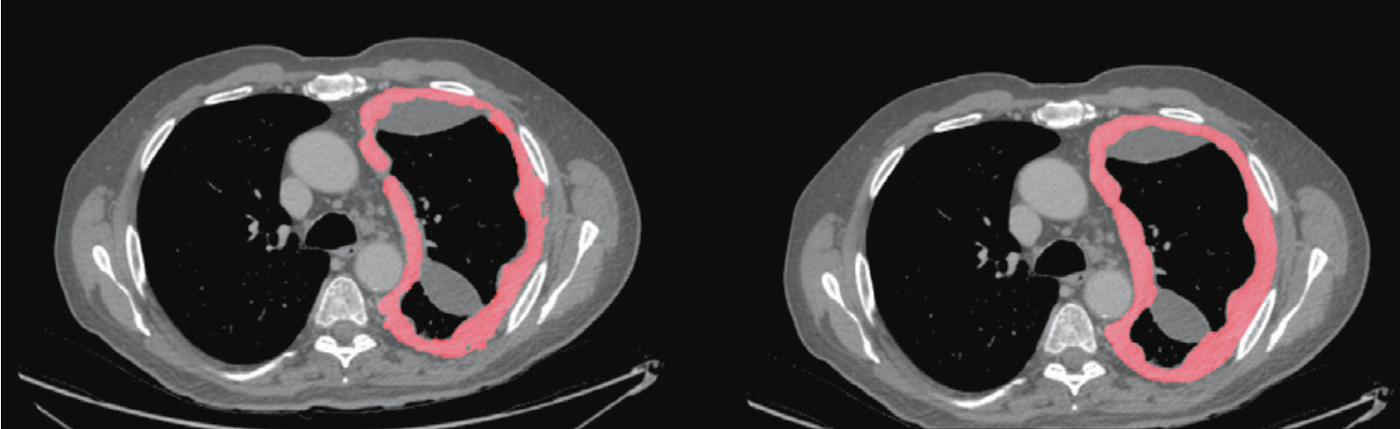
“We've identified some opportunities where we can apply AI solutions to ‘capture low-hanging fruit’, as it were. These are in fairly well-understood patterns of disease which we are training the computer to recognize,” said Dr. Sutherland. “A recently published example is on the cancer, mesothelioma, which is a type of lung cancer that's related to exposure to asbestos1. It creates a very unusual lesion around the lung. It's very debilitating and there's sadly no treatment for it. It generally affects older men who have been previously exposed to asbestos through their work career before regulations came into force.”
Canon Medical Research Europe is working with clinical experts to see if they can find treatments, or if the disease progression can be delayed in any way.
“A critical part of working out if a treatment works is to see the impact on lesions. Mesothelioma lesions are very oddly shaped and have previously been notoriously very difficult to measure. We've created an AI-based system that can measure these lesions and give the clinician some feedback on whether the treatment they're attempting is actually having an effect positively to reduce the tumors or not.”

“Training AI requires a lot of examples provided quickly. In disease, characteristics are more complex to categorize. That’s why radiologists are so precious – they are able to do this type of pattern recognition by training and by their experience.”
Professor Sotirios A. Tsaftaris. University of Edinburgh, UK.
How does a computer see differently to a human?
“Using an analogy of dogs, it’s easy to talk about dog breeds, because everybody sees them and understand them…we know the characteristics that make, for example, a Golden Retriever or a Labrador.
However, if you think about a lesion of the brain, particularly if a patient has had a stroke and there is some sort of hemorrhage in their brain, the hemorrhage can be a variety of locations it will have a variety of appearances…. It is like actually having billions and millions of combinations of possible ‘breeds’.
Challenges in AI
AI is built by feeding large amounts of data through a ‘Deep Learning network’ - a computer model. Statistical processes enable the computer model to slowly find correlations in the data that can indicate clinically significant patterns. The process of feeding data automatically through the model is called ‘training’ the AI. To be successful, Deep Learning requires a lot of data – in some cases, from thousands or millions of examinations.
“Over the last few years, we have seen a ‘rebirth’ of what we call ‘neural networks’. These are very big computer programs that learn patterns through examples. To devise models for these networks these programs take lots of data and lots of computation,” remarked Prof. Tsaftaris. “Bringing all that data together is just one of the many challenges in this arena, but there are wonderful examples of its success, such as how AI-based programming has provided algorithms that can detect a suspicious mole on somebody's skin from a non-suspicious mole.”
Access to patient data with accurate diagnostic or outcome information is essential in creating effective AI solutions. This data is available in hospitals and healthcare facilities, but making it available to others for innovation, has, up until now, presented significant challenges in protecting patient privacy and ethics.
“We have to take genuine responsibility for control and appropriate use of data because it involves very personal information, for example, scans of an individual’s body,” said Dr. Sutherland. “With proper security and data use in place, I believe we can all play a role by giving permission to allow our data as citizens to be used for scientific research for the ‘greater good’. The only way AI is going to work widely is if we apply good, rigorous science that is accepted by patients, healthcare professionals and the general public.”
“Part of the validation process for these technologies also involves clinicians engaging with these systems to help us try and improve their quality and validate that they work in a useful way, “he said. “What computers will never replace is the actual decision-making, in my opinion.”
“They may provide a kind of decision support. For example, the AI may be able to provide a measurement of a lesion that indicates to the doctor whether a treatment is working or not, but the interpretation of what that measurement means is still the key role for the clinician, as well as the communication of that information to the patient and others,” he continued. “What we're doing hopefully is ‘turbocharging’ clinicians, enabling them to do more of what's really important, which is providing care with some of the drudgery done by computers.”
“More data and easy access to this data for academic research is very important,” said Professor Tsaftaris. “This will allow for more rapid development of solutions that then the some of the industry then can really try to translate and integrate.”
Talent requirement
Professor Tsaftaris believes that there are a great many opportunities in using AI to help with the societal challenges that we all face but emphasizes that one critical element that is often not fully appreciated is that talent is required to develop algorithms.
“We need to be able to attract talent. We need to attract software engineers, data scientists, AI experts, AI graduates, and so on. We compete for talent between industries too. So, we need to attract and retain this talent within the healthcare industry,” he said. “There is also a tremendous opportunity for our fellow colleagues and clinicians to play a very important role in this. However, all of this takes time. There is development behind this. Our partners are open to the idea of testing new things and perfecting them while en route to a better future with AI.”
Watch a YouTube video of the full discussion with Professor Tsaftaris and Dr. Sutherland here
Professor Sotirios A. Tsaftaris
Royal Academy of Engineering
Research Chair in Healthcare AI,
University of Edinburgh, UK
Royal Academy of Engineering
Research Chair in Healthcare AI,
University of Edinburgh, UK
Jamie Keenan
Associate Director Health
Unlimited London, UK
Associate Director Health
Unlimited London, UK

Dr. Ken Sutherland
President of Canon Medical
Research Europe
Research Europe
You can also download this article as PDF or the full edition of the respective VISIONS
Other blogs that may interest you
References
1 https://www.canon.co.uk/view/ ai-fighting-cancer/
Social Media


