


Latest news from our
VISIONS Magazine
Urological Prevention in Professional Football
February 28th, 2024
Together with the Charité Universitätsmedizin Berlin (Radiology and Urology Departments) in Germany, Canon Medical Systems supported the testicular cancer screening of 1. FC Union Berlin, with a high-end ultrasound device, directly at their Alte Försterei training grounds in Berlin Köpenick.
Prevention of testicular cancer
Within the last few months, the German premier league, the Bundesliga has been shaken awake by the number of testicular cancer diagnoses that have been reported in the media.
Cancer often affects young men. Between the ages of 20 and 44, a germ cell tumor of the testicles is the most common malignant tumor disease, accounting for around 25% (Bertz et al. 2017). Especially in industrialized countries, including Germany, the incidence has increased over the long-term and is currently 10/100,000 men. Although germ cell tumors of the testicles are considered to be a tumor disease with a high probability of survival.
An early diagnosis is crucial for an adequate and early therapy and thus the prevention of distant metastases. The disease can be detected early with simple precautionary measures and can therefore be treated.
According to guidelines, ‘self-examination’, i.e. regular palpation at intervals of several months, is recommended for testicular cancer. A uroradiological consultation should take place immediately if something is palpated, or if the findings are generally uncertain. According to the current guideline, general screening for the presence of a germ cell tumor should not be carried out. This is justified by the fact that, in addition to the considerable effort, there are also possible disadvantages such as false positive results, the creation of fears and possible complications from diagnostic test procedures.1
Ultimately, discussions remain open, even outside of the guideline committees, because, as is so often the case, it is difficult to weigh up the advantages and disadvantages against each other.
Urological prevention right at the stadium
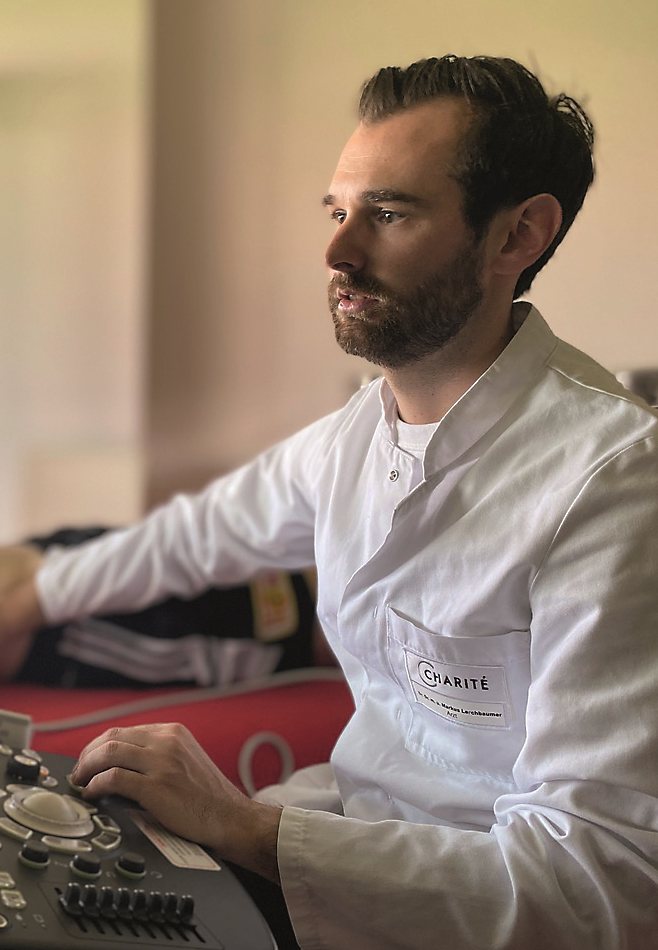
The few studies describing a connection between high-intensity sporting activity (i.e. professional sports, such as football) and the occurrence of testicular cancer showed highly variable and sometimes contradictory results (e.g. Huang et al. 2018). However, the most recent cases in the German Bundesliga sharpened awareness of the necessity and importance of preventive medical check-ups in a generally younger population. For this reason, under the direction of the first team doctor, Dr. Clemens Gwinner (Senior Consultant, Centre for Musculoskeletal Surgery, Charité Campus Mitte), a preventive care day directly the Alte Försterei stadium was organized. Players, staff members (trainer, physiotherapists etc.) and individual officials/ supervisors were initially interviewed for medical history and clinically examined by Dr. Robert Peters. (Senior Consultant; Department of Urology). This was followed by a focused ultrasound examination of the kidneys, bladder, prostate and both testicles by Dr. Markus Lerchbaumer (Consultant at the Department of Radiology, Charité University Medical Center, Campus Mitte in Berlin, Germany). All examinations were carried out in constant consultation between the colleagues from the two disciplines.
"The close cooperation between the two disciplines, which has existed for years, and the associated expertise in this field, is one of the great strengths of the Charité," said Dr. Lerchbaumer.
Testicular sonography: The imaging of choice
Sonography allows rapid and non-invasive diagnosis of inflammatory, tumorous or traumatic diseases of the testicles. The frequency spectrum of modern, broadband linear probes is now between 7 and 24 (up to 33) MHz. Testicular sonography is the imaging method of choice when abnormal palpation or (asymmetric) swelling is discovered. The high spatial resolution of new linear probes significantly improves both the detection and characterization of testicular tumors. The depiction of blood flow is considered the most important parameter in the clarification of testicular tumors, which are usually associated with increased vascularization. In recent years, multiparametric ultrasound (mpUS) has become established. This describes the combination of parameters from B-mode imaging with applications such as color-coded Doppler sonography (CCDS) and shear wave or strain elastography.
Conventional B-mode imaging and CCDS cannot confidently assess vascularization and vessel structure of smaller focal lesions. However, both parameters are groundbreaking in the diagnosis of testicular tumors.
The few studies describing a connection between high-intensity sporting activity (i.e. professional sports, such as football) and the occurrence of testicular cancer showed highly variable and sometimes contradictory results (e.g. Huang et al. 2018). However, the most recent cases in the German Bundesliga sharpened awareness of the necessity and importance of preventive medical check-ups in a generally younger population. For this reason, under the direction of the first team doctor, Dr. Clemens Gwinner (Senior Consultant, Centre for Musculoskeletal Surgery, Charité Campus Mitte), a preventive care day directly the Alte Försterei stadium was organized. Players, staff members (trainer, physiotherapists etc.) and individual officials/ supervisors were initially interviewed for medical history and clinically examined by Dr. Robert Peters. (Senior Consultant; Department of Urology). This was followed by a focused ultrasound examination of the kidneys, bladder, prostate and both testicles by Dr. Markus Lerchbaumer (Consultant at the Department of Radiology, Charité University Medical Center, Campus Mitte in Berlin, Germany). All examinations were carried out in constant consultation between the colleagues from the two disciplines.
"The close cooperation between the two disciplines, which has existed for years, and the associated expertise in this field, is one of the great strengths of the Charité," said Dr. Lerchbaumer.
Testicular sonography: The imaging of choice
Sonography allows rapid and non-invasive diagnosis of inflammatory, tumorous or traumatic diseases of the testicles. The frequency spectrum of modern, broadband linear probes is now between 7 and 24 (up to 33) MHz. Testicular sonography is the imaging method of choice when abnormal palpation or (asymmetric) swelling is discovered. The high spatial resolution of new linear probes significantly improves both the detection and characterization of testicular tumors. The depiction of blood flow is considered the most important parameter in the clarification of testicular tumors, which are usually associated with increased vascularization. In recent years, multiparametric ultrasound (mpUS) has become established. This describes the combination of parameters from B-mode imaging with applications such as color-coded Doppler sonography (CCDS) and shear wave or strain elastography.
Conventional B-mode imaging and CCDS cannot confidently assess vascularization and vessel structure of smaller focal lesions. However, both parameters are groundbreaking in the diagnosis of testicular tumors.
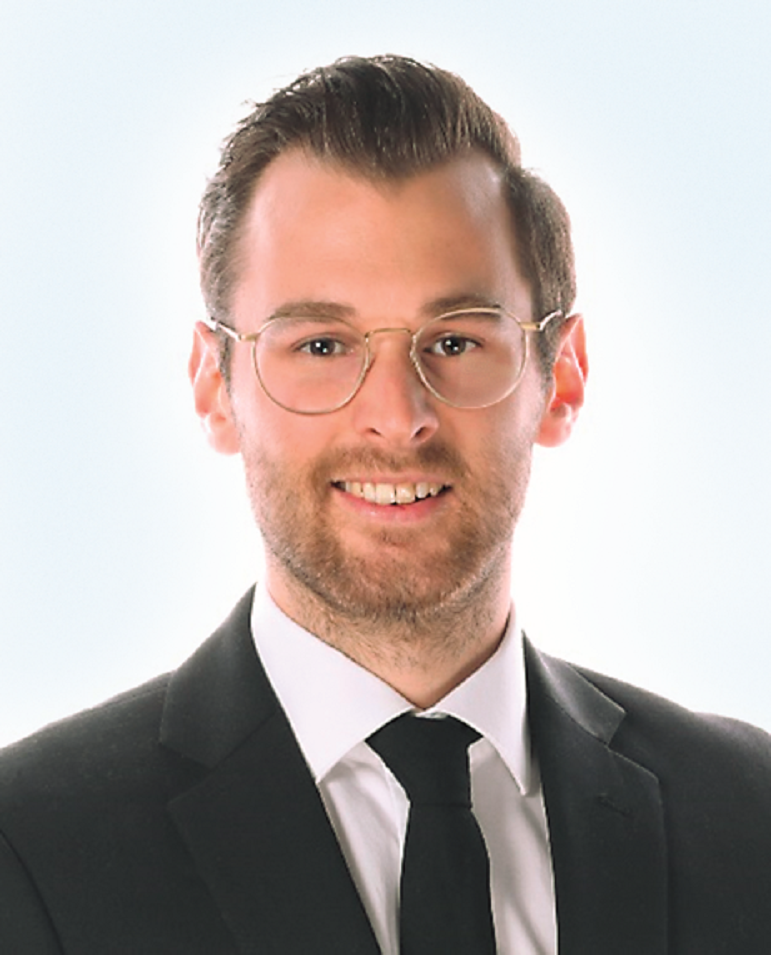
“We know from clinical routine that the clarification by means of sonography after abnormal palpation findings is unfortunately often a bit late.”
Dr. Markus Lerchbaumer,
Department of Radiology.
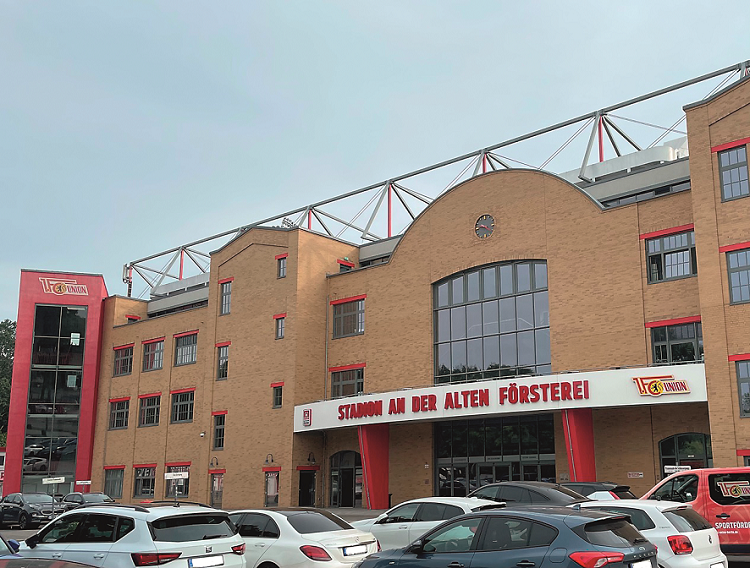 1. FC Union Berlin football stadium "Alte Försterei"
Multiparametric Ultrasound: More than just colorful images
A high-end device Aplio i800 with 18 and 24 MHz intelligent Dynamic Micro Slice (iDMS) matrix transducers was installed for the on-site sonographic examination.
The use of new high-frequency linear probes allows the safe detection of the smallest lesions. Important new applications in testicular sonography are Superb Micro-vascular Imaging (SMI) and shear wave elastography. SMI, as a highly sensitive Doppler method, allows the exact assessment of the vascularity of smaller testicular lesions, where classic CCDS reaches its physical limits. Also in the case of larger lesions, the combined evaluation of the vascular load (hyper- or hypovascularization) and the vascular pattern (chaotic vs. structured) can be used to adequately differentiate between primary and secondary testicular malignancies.
A high-end device Aplio i800 with 18 and 24 MHz intelligent Dynamic Micro Slice (iDMS) matrix transducers was installed for the on-site sonographic examination.
The use of new high-frequency linear probes allows the safe detection of the smallest lesions. Important new applications in testicular sonography are Superb Micro-vascular Imaging (SMI) and shear wave elastography. SMI, as a highly sensitive Doppler method, allows the exact assessment of the vascularity of smaller testicular lesions, where classic CCDS reaches its physical limits. Also in the case of larger lesions, the combined evaluation of the vascular load (hyper- or hypovascularization) and the vascular pattern (chaotic vs. structured) can be used to adequately differentiate between primary and secondary testicular malignancies.
Small, intra-testicular masses in particular often pose a challenge. So-called “minor incidental findings” can now be evaluated with a high level of diagnostic accuracy, which minimizes false-positive findings and avoids unnecessary surgery. The use of SMI in particular has reduced the need for contrast- enhanced ultrasound (CEUS) in recent years.
At Charité, this method is mainly used in unclear cases, findings in Doppler sonography/SMI (e.g. in cases of so-called ‘burnout tumors’), or to assess complications of inflammation (assessment of non-vital parts and abscesses).
Team doctor Clemens Gwinner was pleased with the willingness of the players to participate in the check:
"For several years, Charité has been providing medical care to 1. FC Union Berlin, not only on, but also off the field,” he said. “I am pleased that we were able to carry out the urological check-up so intensively by my colleagues in cooperation with Canon Medical Systems and that it was accepted by the entire team.”
At Charité, this method is mainly used in unclear cases, findings in Doppler sonography/SMI (e.g. in cases of so-called ‘burnout tumors’), or to assess complications of inflammation (assessment of non-vital parts and abscesses).
Team doctor Clemens Gwinner was pleased with the willingness of the players to participate in the check:
"For several years, Charité has been providing medical care to 1. FC Union Berlin, not only on, but also off the field,” he said. “I am pleased that we were able to carry out the urological check-up so intensively by my colleagues in cooperation with Canon Medical Systems and that it was accepted by the entire team.”
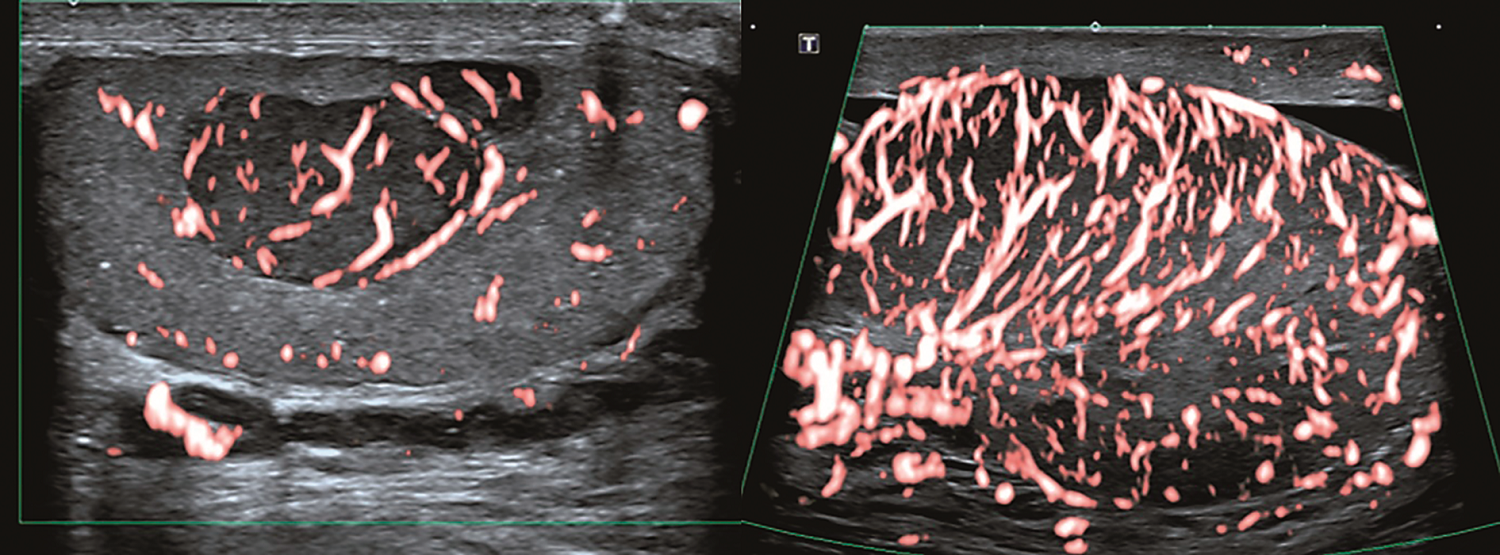
Figure 1: Superb Micro-vascular Imaging (SMI). Intratesticular seminoma (left) with hypervascularization and partly chaotic vessel pattern as well as different vessel calibers. Primary testicular lymphoma (right) with massive hypervascularization and a very orderly vascular pattern without nonvital tumor tissue.
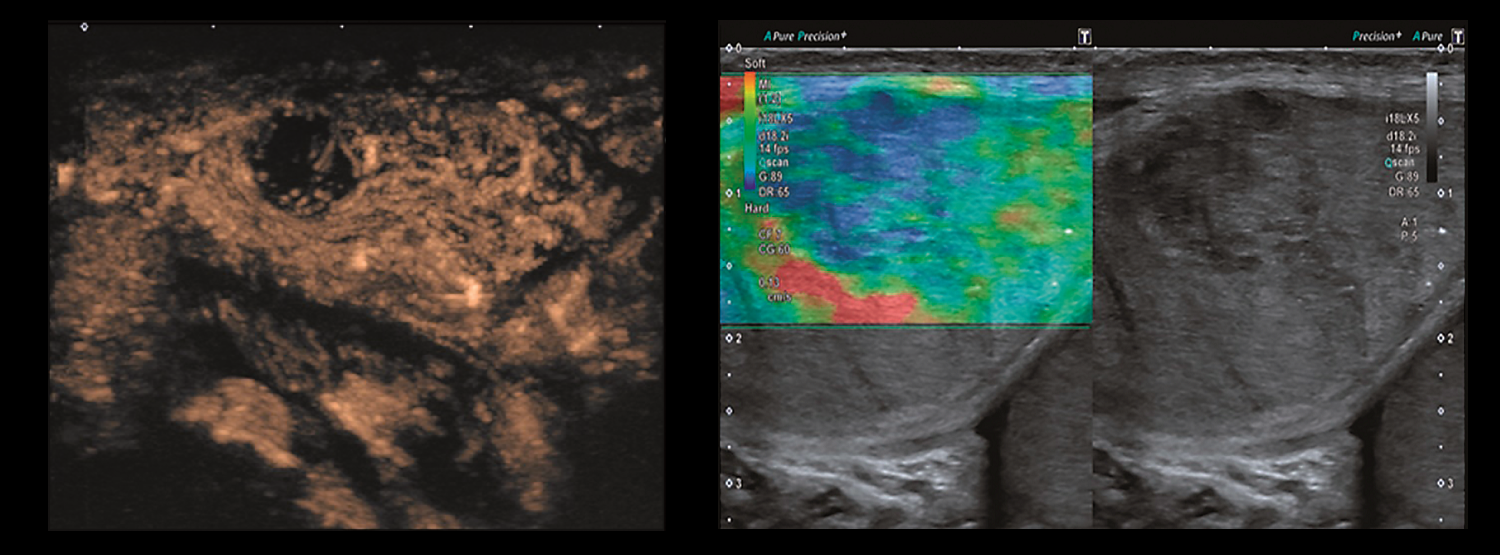
Figure 2: Contrast-Enhanced Utrasound (CEUS) and strain elastography. Burnout tumor with lack of perfusion and thus lack of contrast in the CEUS (left) and ill-defined germ cell tumor with clear hardening (color-coded as blue) compared to the testicular parenchyma in the strain elastography under dynamic compression (right).
“So far there is no 'official' recommendation for preventive health care for young men (except for skin cancer screening from the age of 35). Rapid clarification of an abnormal palpation finding is important.”
Dr. Robert Peters, Senior Consultant;
Department of Urology.
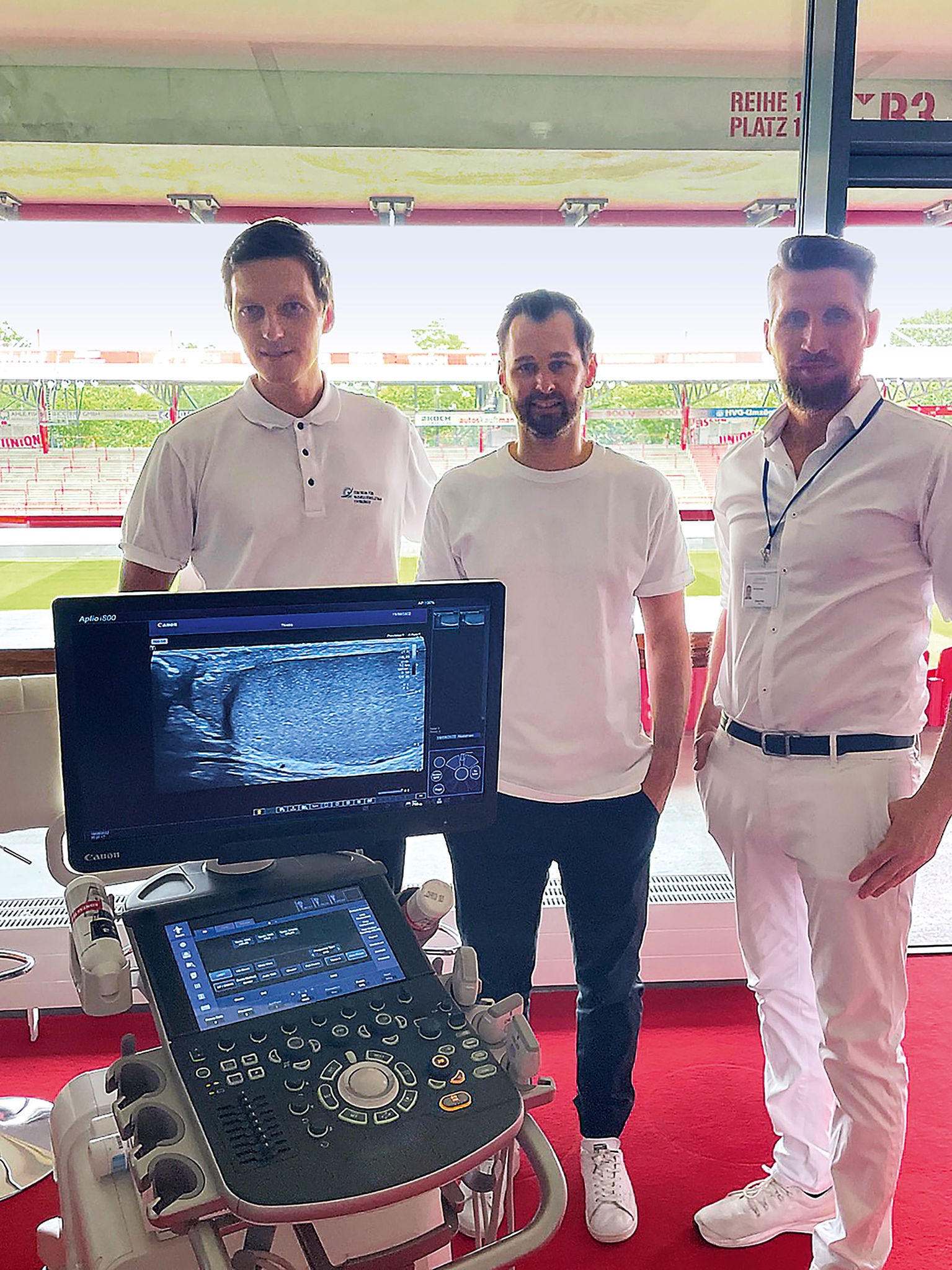 The medical team involved in urological care at Union Berlin: Dr. Clemens Gwinner, Dr. Markus Lerchbaumer and Dr. Robert Peters (left to right).
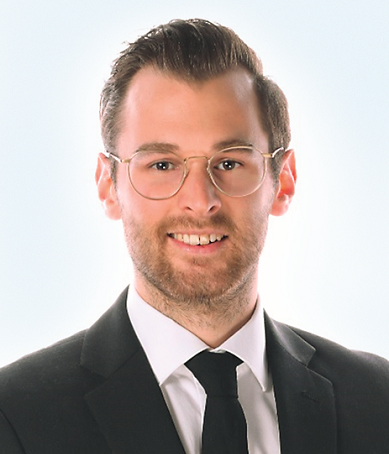
Dr. Markus Lerchbaumer
, (MD)
Dr. Lerchbaumer is a Consultant Radiologist at the Department of Radiology, Charité - Universitätsmedizin Campus Mitte in Berlin, Germany. He is the Research and Teaching Coordinator of the Interdisciplinary Ultrasound Center at Charité. Dr. Lerchbaumer specializes in diagnostic and interventional ultrasound, as well as urogenital and and musculoskeletal imaging.
Dr. Lerchbaumer is a Consultant Radiologist at the Department of Radiology, Charité - Universitätsmedizin Campus Mitte in Berlin, Germany. He is the Research and Teaching Coordinator of the Interdisciplinary Ultrasound Center at Charité. Dr. Lerchbaumer specializes in diagnostic and interventional ultrasound, as well as urogenital and and musculoskeletal imaging.
Other blogs that may interest you
Reference
1
https://www.leitlinienprogrammon kologie.de/ leitlinien/hodentumoren.
Social Media


